tree day
Guide
Why recycling rules differ?
Recycling rules differ because communities have different collection systems, sorting equipment, processors, and markets. A material’s theoretical recyclability does not guarantee a local route, so residents need the current instructions for their provider.

A plastic tub accepted in one town may be rejected in the next, even when both bins are labeled “recycling.” The difference is not necessarily a disagreement about the material itself. Collection contracts, sorting facilities, processing options, and local markets shape what a program can handle. A practical answer is to follow the rules for the service that collects your waste, not a generic list from somewhere else.
Collection is only the first step
For an item to be recycled through a household program, it has to move through several stages: collection, sorting, preparation, and transfer to a processor able to use it. If a community lacks a reliable outlet for a material, collecting it may not produce a useful recycled product. The U.S. EPA’s guide to common recyclables repeatedly directs residents to check local rules, noting that community programs can differ for paper, plastics, glass, aluminum, and other materials. [1]
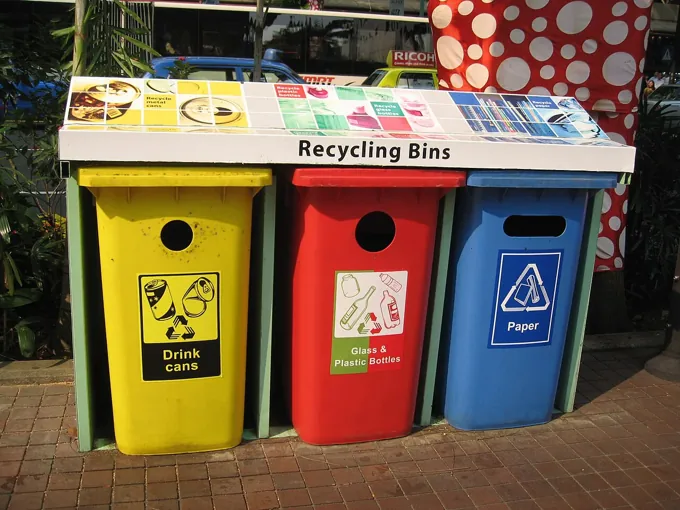
Local rules also reflect the type of service. A single-stream system collects many materials together and sorts them later; a multi-stream service asks residents to separate categories before pickup or drop-off. Equipment and sorting practices influence which objects can be identified and separated reliably. A small item may be difficult for a facility to recover, while a flexible film can tangle in equipment designed for rigid containers. Those technical constraints help explain why a material’s chemical or theoretical recyclability is not enough.
Markets and contamination affect acceptance
After sorting, a facility needs buyers or processors for recovered material. Demand, transportation, quality requirements, and processing capacity can change. An item that once had a local outlet may not have one later, or a program may accept a narrower set of materials to produce a cleaner, more marketable stream. The rules are therefore tied to what the local system can handle, not just to what a product is made from.
Contamination creates another constraint. Food, liquids, non-recyclable packaging, or the wrong plastic can lower the quality of a collected load or interfere with sorting. EPA’s guidance, for example, says plastic containers with food debris cannot be recycled and recommends removing residue where the container is accepted. [1] The exact preparation required still depends on local instructions. Programs may set different standards because their collection equipment and downstream processors have different tolerances.
Same material, different object
Labels such as “paper,” “plastic,” and “metal” conceal important differences. A cardboard box, a greasy takeout carton, a laminated gift wrap, and shredded paper all belong to broad paper categories, yet they may require different handling. EPA notes that some paper and cardboard items are generally recyclable, while shredded paper and some food containers depend on local program rules. [1] Likewise, plastic bottles, utensils, bags, and compostable packaging do not share one recycling route.
A hypothetical resident moving between two counties might find that both accept aluminum cans but only one accepts a specific plastic tub. The material has not changed; the collection and processing pathway has. That is why advice from a friend, package label, or old move-in leaflet can mislead. The useful reference is the current accepted-items list from the actual hauler or local government serving the address.
How to handle uncertainty
When rules are confusing, check the exact item name and form, not just the material category. Is it a rigid container, film, foam, mixed-material package, battery, or electronic device? Does the provider specify whether to empty, rinse, flatten, or separate components? If no instruction appears, use the provider’s help line or site search. For items excluded from curbside service, ask about drop-off locations or special collection days.
A common mistake is “wish-cycling”: putting an uncertain object in the bin in the hope it will be recovered. That can create extra sorting work or contaminate material that could otherwise be used. Another mistake is assuming that all local instructions are permanent. Programs can change when facilities or contracts change. A sensible next step is to bookmark the service’s accepted-material guide and check it when you encounter a new package, especially before placing batteries, electronics, plastic film, or food-soiled items in a cart.
Follow the evidence
Primary sources used in this story. Practical examples are illustrative unless a source states otherwise.
Read our editorial standards. Have a correction? Identify the article and relevant source in your feedback to the site owner.