tree day
Guide
When to stake a tree?
Most newly planted trees do not need support, but staking can help where wind, mower damage or vandalism pose a real risk. Decide based on movement and exposure, and keep any support temporary and flexible.
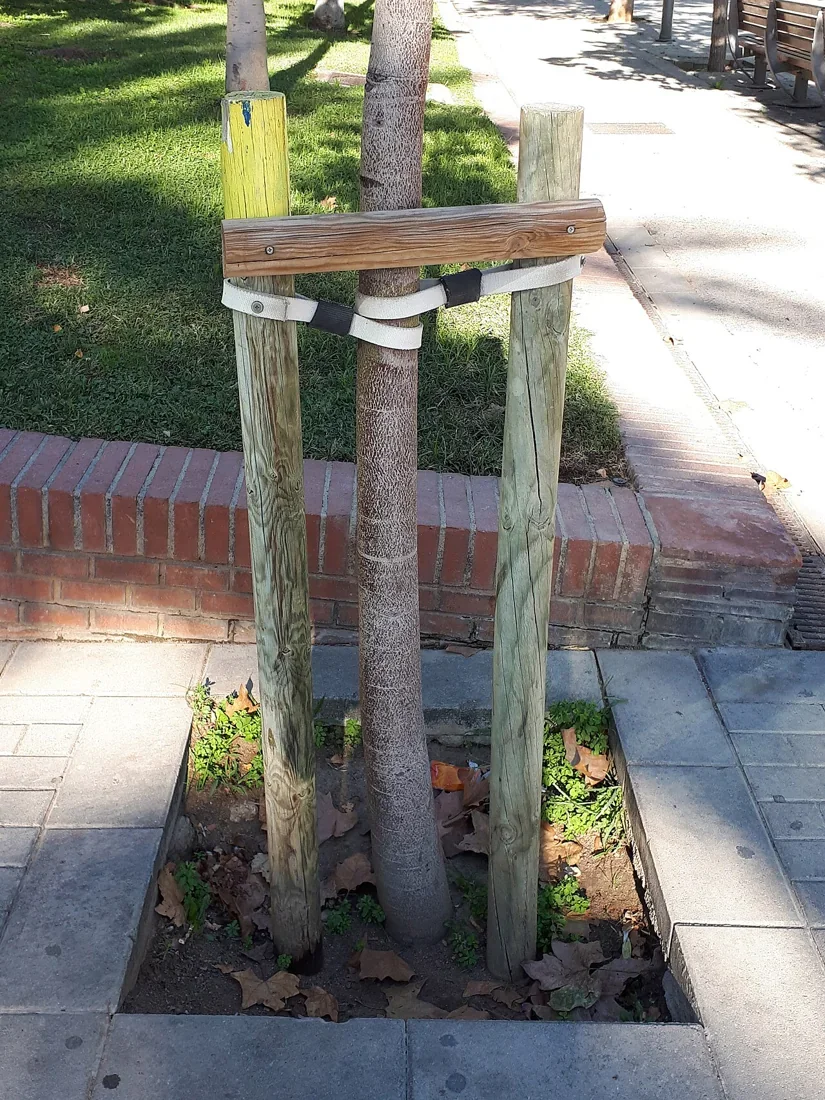
A newly planted tree usually does not need stakes simply because it is young. The key question is whether it can remain upright and stable in its actual site. Staking may help in very windy conditions or where protection from mowers or vandalism is needed, but support that is unnecessary or left too long can interfere with the tree’s natural movement.
Begin with the reason for support
New York’s Department of Environmental Conservation says staking is not usually necessary and notes that trees can develop stronger trunk and root systems without being staked at planting. It identifies very windy sites and risks such as lawn mower damage or vandalism as reasons protective staking may be needed. [1]
That makes staking a response to a site condition, not a routine step in every planting. Consider whether the tree is exposed to strong wind, whether its root ball moves when the trunk shifts, and whether stakes would guard it from a specific hazard. A protected planting site may need no stakes at all.
Support should allow some movement
A tree’s trunk needs to move as it grows. A support arrangement that holds it rigidly can prevent that natural movement, while loose or poorly placed ties can rub the trunk. The references establish that staking is usually unnecessary, but do not supply a universal hardware setup or exact tie tension. [1]
If staking is warranted, use a method recommended for the tree type and local conditions, and check that ties do not press into bark. The aim is to address the identified risk while allowing the tree to respond to ordinary movement. If you are unsure how to support a large or unstable tree, consult an arborist rather than improvising a rigid anchor.
Planting quality comes first
Stakes cannot compensate for a poorly planted tree. The DEC says the trunk flare should be at the soil line and advises digging a hole wide enough for roots to spread; it also recommends firm soil beneath a balled-and-burlapped root ball to prevent settling. [1] Those details help the tree establish, whether or not temporary support is used.
For example, imagine a small tree planted in an exposed yard where gusts rock the root ball. The issue is not that all young trees need stakes; it is that this particular site may need temporary support while the tree establishes. A tree in a sheltered garden with a stable root ball may do better without it.
Protection and support solve different problems
A stake can help stabilize a tree, but it does not keep deer from browsing or protect the trunk from all physical damage. For seedlings in rural or natural areas, the DEC says tree tubes or other protections can deter hungry wildlife. [1] Separately, the Arbor Day Foundation recommends fencing where rabbits, deer or other wildlife feed at a site. [2]
Choose protection for the risk you actually see. A barrier around a tree addresses browsing; support addresses movement or exposure. Combining them without considering the tree’s growth can create rubbing, crowding or a barrier that is hard to maintain.
Recheck instead of leaving stakes indefinitely
Temporary support needs follow-up. Inspect ties and the trunk for rubbing or constriction, and see whether the tree stands firmly as it establishes. The references do not state a universal removal date, so avoid treating one calendar interval as right for every tree and site.
If a tree remains unstable or the risk persists, ask a qualified arborist to assess it. Otherwise, once it can stand securely and support is no longer needed, remove the stakes and ties. The next step is a site-specific check, not automatic staking at every planting.
Follow the evidence
Primary sources used in this story. Practical examples are illustrative unless a source states otherwise.
Read our editorial standards. Have a correction? Identify the article and relevant source in your feedback to the site owner.