tree day
Guide
How do trees absorb carbon dioxide?
Trees take in carbon dioxide through leaf pores and use carbon from it in photosynthesis. Some carbon becomes part of woody growth and roots, while stored carbon can return to the atmosphere as tissues decay or burn.
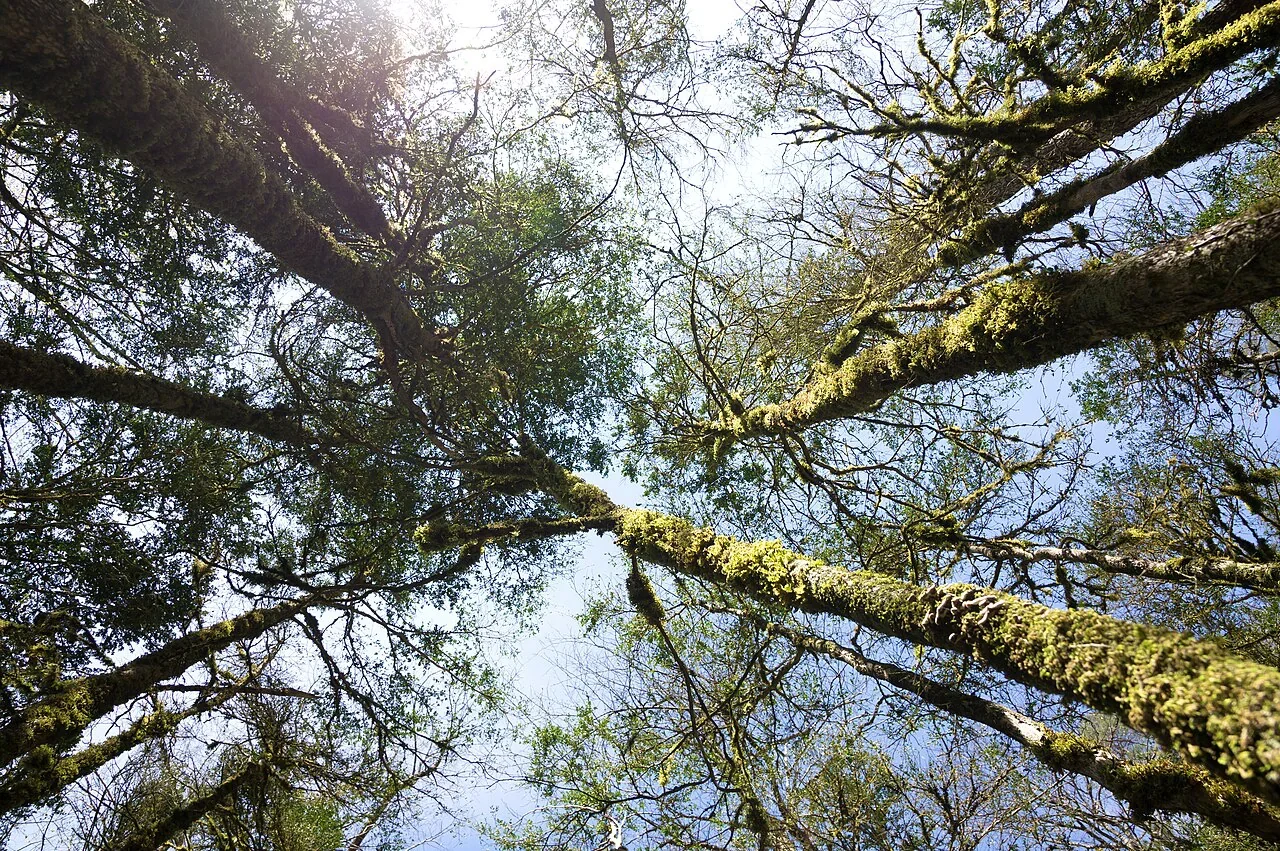
Trees absorb carbon dioxide through tiny pores in their leaves, then use the carbon in photosynthesis to build sugars. Some of that carbon becomes part of new wood, roots and other tissues. The process moves carbon from the air into living biomass, but storage is not automatically permanent: carbon can return to the atmosphere as a tree or its remains decompose or burn.
From air to leaf
Carbon dioxide enters a leaf through small openings called stomata. Inside the leaf, photosynthesis uses light energy to combine carbon dioxide and water into sugars, releasing oxygen as a byproduct. The sugar supplies energy and raw material for the tree’s growth and maintenance. [3]
A tree’s leaves are where much of this exchange happens, but its ability to take up carbon depends on many factors, including species, size, season and growing conditions. A newly planted tree and a mature tree do not have identical canopies or growth rates, and no single simple number describes all trees.
Carbon becomes plant tissue
As the tree grows, some carbon from the sugars becomes part of its wood, bark, roots, leaves and reproductive structures. This is why a growing tree can store carbon in its biomass. Carbon also moves through the tree as it respires and uses sugars, so absorption does not mean every molecule taken in remains stored.
The tree’s roots and surrounding soil matter to the larger picture too. Dead leaves, fine roots and other organic material can contribute carbon to soil as they decompose, though the amount and persistence depend on local conditions and management. The process is gradual and varies widely by site.
Storage has a time dimension
A living tree holds carbon while it grows, but that storage can change. If wood decomposes, burns or is removed and used in ways that release carbon, some stored carbon returns to the atmosphere. Long-lived trees and durable wood products can retain carbon for different periods, while disturbance and decay alter the balance.
That makes tree planting a long-term biological process rather than an instant offset. The New York DEC describes trees as providing benefits such as shade, stormwater reduction and air and water pollution reduction, and emphasizes choosing the right tree for the right site so it can grow and live well. [1] These are practical reasons to plant that do not require treating one tree as a precise carbon calculation.
Growth depends on a suitable site
A tree cannot build much new tissue if it is stressed or poorly matched to its location. Soil, sunlight, available root space, water and climate all affect establishment and growth. The Arbor Day Foundation says proper care begins with selecting a tree that can thrive at the site, and notes that the first few years affect its shape, strength and lifespan. [2]
For a hypothetical homeowner, this means a locally suitable tree with adequate mature space may be a sounder choice than a fast-growing tree that outgrows the yard or struggles in its soil. If it declines or needs early removal, the intended long-term storage and other benefits are reduced.
Plant for durable benefits
When choosing a tree, consider its mature size, soil, sun and water needs, and whether nearby structures or utilities constrain growth. The DEC recommends assessing these site conditions before purchase and says most roots extend beyond the canopy width. [1] If planting requires digging, have underground utilities located through the relevant local service first.
Do not infer a precise carbon benefit from a tree’s species name alone. Growth and storage depend on the tree’s actual size, health, lifespan and surroundings. Choose a tree suited to the site, establish it with locally appropriate care, and think of carbon uptake as one benefit among several that accrue over time.
Follow the evidence
Primary sources used in this story. Practical examples are illustrative unless a source states otherwise.
- New York DEC: How to plant a tree ↗
- Arbor Day Foundation: Tree care and maintenance ↗
- Penn State Extension: Planting trees in your community forest ↗
Read our editorial standards. Have a correction? Identify the article and relevant source in your feedback to the site owner.