tree day
Guide
What is a keystone species?
A keystone species has an ecological influence that is especially large relative to its abundance. The label describes a species' role in a particular community, not a universal ranking of which organisms matter most.
A species can be scarce and still shape what happens across a habitat. Ecologists use keystone species for a species whose effects on its community are especially large relative to its abundance. The idea focuses attention on influence and relationships, not simply on which organism is biggest, most numerous, or most familiar.
The role is defined by effects
A keystone species can affect the availability of food, habitat, or other conditions that many organisms depend on. Its influence may come through predation, grazing, engineering habitat, or another relationship. The key point is disproportionate effect: removing or sharply reducing the species can change the community more than its abundance alone might suggest.
That does not mean every species with a visible ecological role is a keystone. A species may be useful, abundant, or culturally important without fitting this particular ecological description. Biodiversity includes many forms of life and levels of organization, as the National Park Service notes [1]; the keystone label identifies one kind of community influence within that wider picture.
Why abundance is not the same as importance
A common plant may provide food and shelter across a large area, while a less common predator may regulate another population. Either could matter, but for different reasons. Counting individuals answers how common a species is; identifying a keystone role asks what changes when that species' relationships are altered.
The distinction matters in conservation conversations. Protecting a species because it is rare, threatened, or valued can be justified on grounds that do not require calling it a keystone. Conversely, a keystone species need not be the rarest member of its community. These terms describe different properties and should not be used as synonyms.
A food web helps reveal possible effects
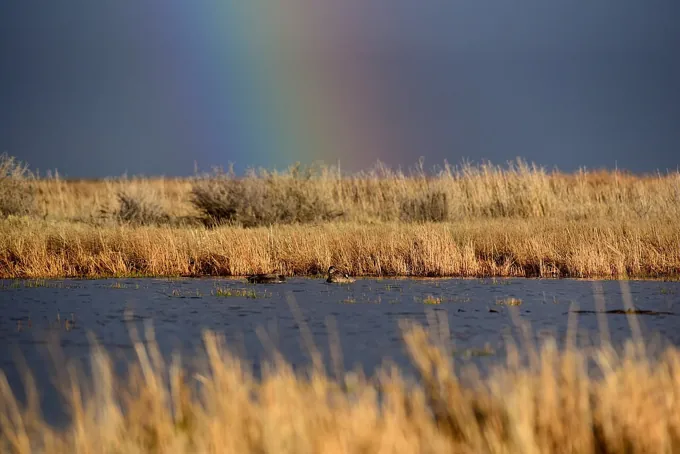
Imagine a hypothetical wetland where one predator feeds on several smaller consumers that in turn graze on plants. If the predator's presence limits grazing, its decline could allow consumers to change plant cover, potentially affecting other species that use the vegetation. This is an illustrative pathway, not a prediction about every wetland or proof that any particular predator is a keystone.
The example shows why a web is more informative than a simple list. A species' effect depends on its links to prey, competitors, habitat, and environmental conditions. A food web can suggest where to look, but field observations and careful studies are needed to establish the strength and direction of effects in a real place.
The designation depends on place
The same species can have different effects in different communities. Its abundance, available prey, competitors, and environmental setting may change from one location to another. So a keystone designation should be grounded in a particular ecosystem and supported by evidence about what the species does there.
This is also why an invasive species is not automatically a keystone species. The National Invasive Species Information Center defines invasive species in relation to being nonnative and causing or likely to cause harm [2]. That definition concerns origin and harm; keystone describes ecological influence relative to abundance. The categories can overlap, but neither implies the other.
What the label can and cannot do
The term can help prioritize questions: which relationships would be most affected by a species' loss, and which changes might follow? It cannot replace a full assessment of habitat or community condition. Focusing on one celebrated species can leave less visible organisms and broader processes out of view.
If you encounter the term in a local conservation proposal, ask what evidence shows the species has a disproportionate influence in that specific setting. Look for the relationships described and the scale at which they were observed. The next useful choice is to support a habitat assessment that considers both the focal species and the community around it.
Follow the evidence
Primary sources used in this story. Practical examples are illustrative unless a source states otherwise.
- US National Park Service: What is biodiversity? ↗
- National Invasive Species Information Center: What are invasive species? ↗
Read our editorial standards. Have a correction? Identify the article and relevant source in your feedback to the site owner.